QI 101 for Nurses
Lately, I’ve been thinking a lot about the how of change.
Not the big, sweeping practice changes—but the small ones. The subtle adjustments we make in workflows, documentation, or daily routines. When you work with a large NICU team, it can feel incredibly challenging to reach everyone, communicate clearly, and still make people feel genuinely heard. I care deeply about valuing input and creating space for feedback, but I’ll be honest... sometimes it feels hard to do that well in a busy, complex system.
As this new year begins, I’ve noticed something shift in my own professional goals.
In the past, my goals often centered around doing more: presenting at conferences, launching new initiatives, completing (and sustaining) quality improvement projects, and developing new programs for my team. Those goals still matter to me but this year feels different.
This year, I’m focusing more on reflection.
More active listening.
More intentional pauses.
More celebration of what’s already working.
I tend to be in “go, go, go” mode, and I’m realizing that growth doesn’t always come from moving faster. Sometimes it comes from slowing down enough to really see the system. To notice where it supports us and where it quietly creates barriers.
If I could make one small change this year, it would be having the ability to read minds! LOL I wish! Cause then I could instantly identify system blocks and remove them. Of course, I can’t do that. But what Icando is listen. And in my role as a CNS, hearing from frontline nurses is absolutely instrumental. You see the gaps. You feel the friction. You live the work every shift.
That’s where meaningful quality improvement begins.
And my hope is that this reflection not only guides my own practice this year, but also inspires bedside nurses and nurse leaders alike to recognize that their observations, questions, and “itches” are powerful starting points for change.
Click Here to Download My QI Project Workbook
The New Year always brings a wave of reflection.
Many of us start thinking about growth professionally, personally, and clinically. For NICU nurses, that often shows up as questions like:
"I need a QI project for my clinical ladder, but I don't know what to do." "What's a good QI project?" "Everything feels like it's already been done."
If that sounds familiar, you're not behind and you're definitely not alone.
Strong QI projects don't start with big ideas. They start with noticing friction.
QI doesn't begin with an idea. It begins with an "itch."
Most meaningful quality improvement work starts at the bedside. It sounds like:
Why does this feel so inefficient every shift? Why do we keep running into the same problem? Why does this process look different depending on who's working? Why do the same questions keep coming up?
If something consistently catches your attention, that's not random. It's data. That "itch" is often the beginning of a powerful, nurse-driven QI project.

Nurse-driven doesn't mean nurse-only
Many nurse-sensitive indicators like infection prevention, thermoregulation, IVH prevention, and ventilator care are absolutely driven by nursing practice.
Most NICU QI projects are interdisciplinary by nature, and that's a good thing.
When you collaborate with different stakeholders, quality gets addressed from all angles. Each discipline brings unique insights to the table. Nurses notice workflow inefficiencies that happen whether at 3 PM or 3 AM. Respiratory therapists spot ventilator patterns others might miss. Physicians identify medical management issues and workflow bottlenecks. Occupational therapists recognize developmental concerns that can affect the baby for years. Dietitians see barriers to effective growth and nutrition optimization. Speech therapists catch feeding readiness cues and oral motor challenges.
Everyone's voice matters, but one of the most important voices is often missing from our QI teams: NICU families.
The power of family partnership
Including a family advisor transforms your project. Parents bring a completely different lens to the work. They notice the confusing signage that staff walk past daily. They feel the anxiety of inconsistent communication between shifts. They understand which "small" improvements actually have huge impacts on their NICU journey.
Family advisors help us remember why we're doing this work. When discussions get bogged down in logistics or politics, a parent's perspective brings us back to what really matters: the baby and family at the center of our care.
Consider asking a graduate parent to join your team. Many are eager to help improve the experience for future families. Their input during PDSA cycles can reveal blind spots you never knew existed.
Nurses are uniquely positioned to see how systems connect: bedside care, respiratory support, medication use, family engagement, delivery room practices, and unit workflows. If your project touches more than one discipline, it doesn't make it harder. It makes it stronger.
A step-by-step framework for a meaningful QI project
1. Identify your stakeholders early
Before changes are tested or plans are written, ask yourself who is involved in this process, who influences it upstream, who feels the downstream effects, and who needs to be part of the conversation. Stakeholders are important information sources. Bringing people in early builds trust and prevents rework later. Some people/groups to think about include:
Does your NICU have a nursing governance council or a unit practice council?
Does your NICU have family advisors or parent volunteers?
Nursing Leadership
Medical Director and APRN/PA colleagues
Respiratory Therapists
Neonatal Therapy
Social Work and Case Management
Other departments (Pediatrics, PICU, Labor and Delivery, Postpartum, Emergency Department etc.)
Supply Chain
Technical Support (e.g. Epic/Cerner experts)
Pharmacy
Etc.
2. Look at the data you already have
You don't need to start from scratch. Many units already track infection rates, compliance measures, documentation elements, audit data, family experience feedback, and process timing and consistency.
Start by exploring what's already being collected:
Time-based metrics:How long until first skin-to-skin? What's the average time from delivery to first feed? How quickly are admissions completed? These timing elements often reveal workflow inefficiencies or inconsistent practices.
Compliance data:Your unit likely tracks delayed cord clamping rates, hand hygiene audits, or bundle compliance (VAP bundles, CLABSI bundles, CAUTI prevention). Look for patterns. Is compliance different on nights versus days? Do certain patient populations have lower rates?
Clinical outcomes:Beyond the big indicators like VAP rates or CLABSI rates, consider unit-specific metrics. Are unplanned extubations clustered around certain times? Do feeding intolerance rates vary by feeding protocol adherence?
Process consistency:Documentation audits, admission completeness, discharge teaching elements. Where you see variation, there's often opportunity.
Ask yourself what you can measure reliably, what reflectsthe process(not just the outcome), and what would tell you if things are actually improving. Simple, consistent data is far more useful than perfect data.
For example, if you're interested in skin-to-skin practices, you might already have documentation of first hold times, parent presence data, and even staff assignment patterns. You don't need to create a complex new tracking system. Start with what exists and build from there.
3. Set a clear, meaningful goal
This is where intention becomes direction. Most of us learned about SMART goals in nursing school:
Specific
Measurable
Achievable
Relevant
Time-bound
These criteria create structure and accountability for any QI project.
I'm currently reading"Your Best Year Ever" by Michael Hyatt, and he expands this framework to SMARTER goals by adding two critical elements: Exciting and Risky.
Excitingmeans the goal energizes you. In QI terms, this is the difference between "reduce CLABSI rates by 10%" and "achieve 500 days without a CLABSI." Both are measurable, but one creates momentum and unit pride.
Riskymeans stretching beyond what feels guaranteed. Not reckless, but ambitious enough that you'll need to innovate and engage others to succeed. A goal that requires no real change in practice probably won't create lasting improvement.
Consider these two goals:
"Increase skin-to-skin documentation from 75% to 80% by March"
"Achieve skin-to-skin within 2 hours of birth for 95% of intubated infants by March"
The second goal is riskier and more exciting. It challenges traditional concerns about respiratory support, requires real culture change, and success would genuinely transform the parent-infant bonding experience.
Most importantly, your goal should matter to patients, families, or staff. Clarity helps keep the project focused and realistic while ambition keeps it meaningful.
4. Use PDSA cycles to test small changes
PDSA stands for Plan-Do-Study-Act, and it's the engine that drives quality improvement forward. Think of it as the scientific method applied to clinical practice.
Plan:Define what you're testing, who will test it, when, and how you'll know if it worked. Be specific. "We'll try a new admission checklist with three nurses on day shift Tuesday and track completion time and missing elements."
Do:Run the test exactly as planned. Document what actually happens (not just what was supposed to happen). Did those three nurses use the checklist? What questions came up? What got in the way?
Study:Compare what happened to what you predicted. Did the checklist save time? Were fewer elements missed? What surprised you? This is where learning happens.
Act:Based on what you learned, decide your next step. Adopt the change, adapt it based on feedback, or abandon it and try something different.
As Kaplan and Gupta (2023) emphasize in their editorial, successful NICU improvement requires "rapid-cycle testing" where multiple small PDSA cycles build on each other. They note that NICUs achieving breakthrough improvements typically run weekly or even daily cycles rather than waiting months between tests.
You are testing a change, not implementing a permanent solution. Start small with one shift, one population, one team, or one change.
For example, if you're working on time to first skin-to-skin, your first PDSA might test a simple reminder card at one delivery. The next cycle might refine the card based on feedback. The third might test it with all deliveries on one shift. Each cycle informs the next.
If a test doesn't work, that's not failure. It's information that saves you from implementing something ineffective unit-wide.
Real NICU examples of PDSA progression:
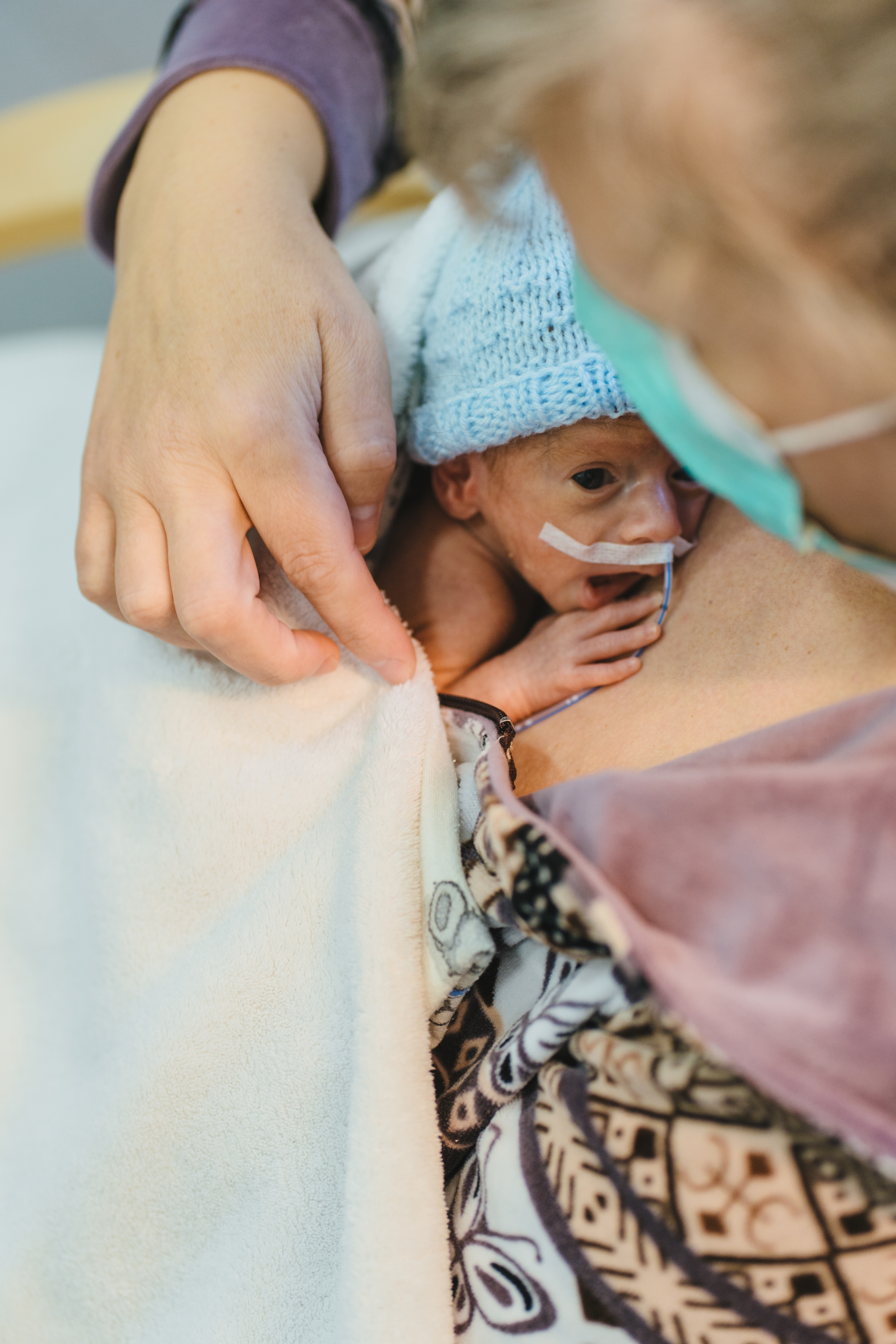
Reducing Unplanned Extubations (Merkel et al., 2014)A NICU reduced unplanned extubations from 4.6 to 0.6 per 100 ventilator days through sequential PDSA cycles:
Cycle 1: Tested two-person care for all ETT manipulations with one pod of babies
Cycle 2: Added standardized taping method after feedback about inconsistent securing
Cycle 3: Implemented "safety pause" before repositioning on all shifts
Cycle 4: Created visual cues (red dots) on isolettes for high-risk infants Each cycle lasted 2 weeks, building on lessons from the previous test.
Golden Hour Protocol (Castrodale & Rinehart, 2014)Team improved admission temperatures for preterm infants through rapid cycles:
Cycle 1: Tested pre-warming the radiant warmer for one week (small improvement)
Cycle 2: Added chemical warming mattress for infants <29 weeks (better results)
Cycle 3: Introduced polyethylene wrap immediately at delivery (significant improvement)
Cycle 4: Created admission "golden hour" checklist combining all successful elements Result: Admission hypothermia decreased from 44% to 6%.
Donor Milk Implementation (Parker et al., 2013)NICU increased donor milk use from 0% to 81% of eligible infants:
Cycle 1: Tested consent process with 5 families to identify barriers
Cycle 2: Revised consent form based on parent feedback, tested with next 10 families
Cycle 3: Created bedside identification system to prevent errors
Cycle 4: Implemented automated EMR alerts for eligibility Small tests over 3 months led to sustainable system-wide change.
Central Line Maintenance Bundle (Kaplan et al., 2011)Cincinnati Children's NICU eliminated CLABSI for over 300 days:
Cycle 1: Tested daily line necessity checklist during rounds on one team
Cycle 2: Added "scrub the hub" competency validation for 10 nurses
Cycle 3: Implemented line maintenance observations with immediate feedback
Cycle 4: Created visual management board showing days without infection
Each test lasted 1-2 weeks before expanding.
Kangaroo Care for Ventilated Infants (Hendricks-Muñoz et al., 2013)Team increased KC for ventilated babies from 20% to 82%:
Cycle 1: Tested transfer protocol with one stable ventilated infant
Cycle 2: Refined positioning technique based on nursing concerns
Cycle 3: Added respiratory therapist to transfer team
Cycle 4: Created parent education video showing safe transfer
Cycle 5: Implemented "KC rounds" to identify eligible babies daily
Progressive cycles over 6 months normalized previously rare practice.
Each cycle should be quick (days to weeks, not months) and build directly on what you learned from the previous test.
5. Share the work
Don't let your project end quietly. Sharing your work helps other nurses learn faster, strengthens unit culture, builds confidence and leadership skills, and turns individual effort into collective improvement.
That might look like:
A staff meeting discussion
A unit poster
A council presentation
A conference abstract
Informal peer teaching
Ready to share beyond your unit? Consider these opportunities:
National Conferences:
NANN Annual Conference- Abstract submissions typically open in early spring for fall conference. Perfect venue for bedside-driven QI projects with direct clinical impact.
ANN National Neonatal Nursing Conference- Accepts QI project submissions for poster and podium presentations. Strong focus on nursing leadership and innovation.
Synapse Care Solutions ONE Conference- Specifically designed for NICU nurses to share their meaningful work. Abstract deadline will be coming up soon. Excellent venue for nurse-driven projects showing how ONE nurse can make all the difference.
Regional and Virtual Options:
Regional NANN chapters often host smaller conferences with less competitive abstract acceptance
Many organizations now offer virtual poster sessions, reducing travel barriers
Hospital systems frequently have internal QI symposiums
First-timer tips:Start with a poster presentation. They're less intimidating than podium talks and provide great networking opportunities. Most conferences offer mentorship programs for first-time presenters.
When we share our work, we shorten someone else's learning curve. Your "small" project addressing medication errors or feeding protocols might be exactly what another unit needs to see.
A New Year, a new way of seeing your practice
You don't need a groundbreaking idea to lead meaningful change.
You need curiosity. You need awareness. You need the courage to ask, "Why do we do it this way, and could it be better?"
That's how nurse-led quality improvement starts. And that's how nurses grow into leaders, often before they even realize it. That is definitely how I grew from bedside nurse to nurse educator and now Clinical Nurse Specialist!

Here's to a new year, a new lens, and meaningful work that truly improves care.
Stay curious,
Amanda
Some links in this newsletter are affiliate links, which means I may earn a small commission if you choose to purchase—at no extra cost to you. I only recommend products and resources I truly believe add value for NICU nurses.
© 2025 This content is for educational purposes and should complement, not replace, your unit's policies and procedures.
Missed my other newsletters? Click here to read them!
Reference:
Kaplan, H. C., & Gupta, M. (2023). A Tipping Point for Quality Improvement in Neonatal Intensive Care.Clinics in perinatology,50(2), xix–xxi.https://doi.org/10.1016/j.clp.2023.03.001
Castrodale, V., & Rinehart, S. (2014). The golden hour: Improving the stabilization of the very low birth-weight infant. Advances in Neonatal Care, 14(1), 9-14.
Hendricks-Muñoz, K. D., et al. (2013). Skin-to-skin care and the development of the preterm infant oral microbiome. American Journal of Perinatology, 30(10), 869-874.
Kaplan, H. C., et al. (2011). The model for understanding success in quality (MUSIQ): Building a theory of context in quality improvement. BMJ Quality & Safety, 21(1), 13-20.
Merkel, L., et al. (2014). Reducing unplanned extubations in the NICU. Pediatrics, 133(5), e1367-e1372.
Parker, M. G., et al. (2013). Promoting human milk and breastfeeding for the very low birth weight infant. Pediatrics, 132(5), e1260-e1269.
Copyright © {{right_now.year}} {{location.name}}, All rights reserved.
Our mailing address is:
{{location.email}}


